A second read of every claim file.
Fraud Triage reads a claim's documents, flags potential inconsistencies, and shows the evidence behind each flag. Your claims and SIU teams decide what happens next.
Fraud Triage is in pilot.
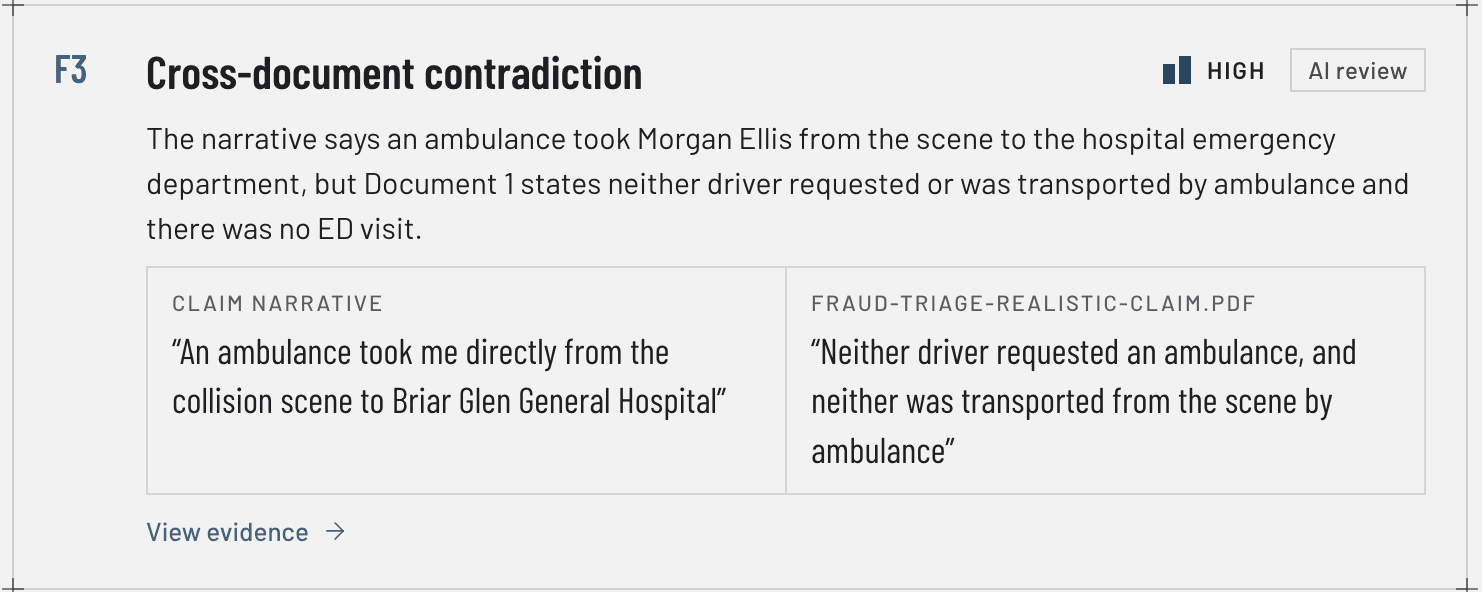
The detail that matters is rarely on page one.
A single claim file can hold a loss notice, a police report, repair estimates, photos and letters. A date that doesn't line up, or an amount that changes between documents, can sit anywhere in it. Reviewers find it when they have time, and they rarely have time.
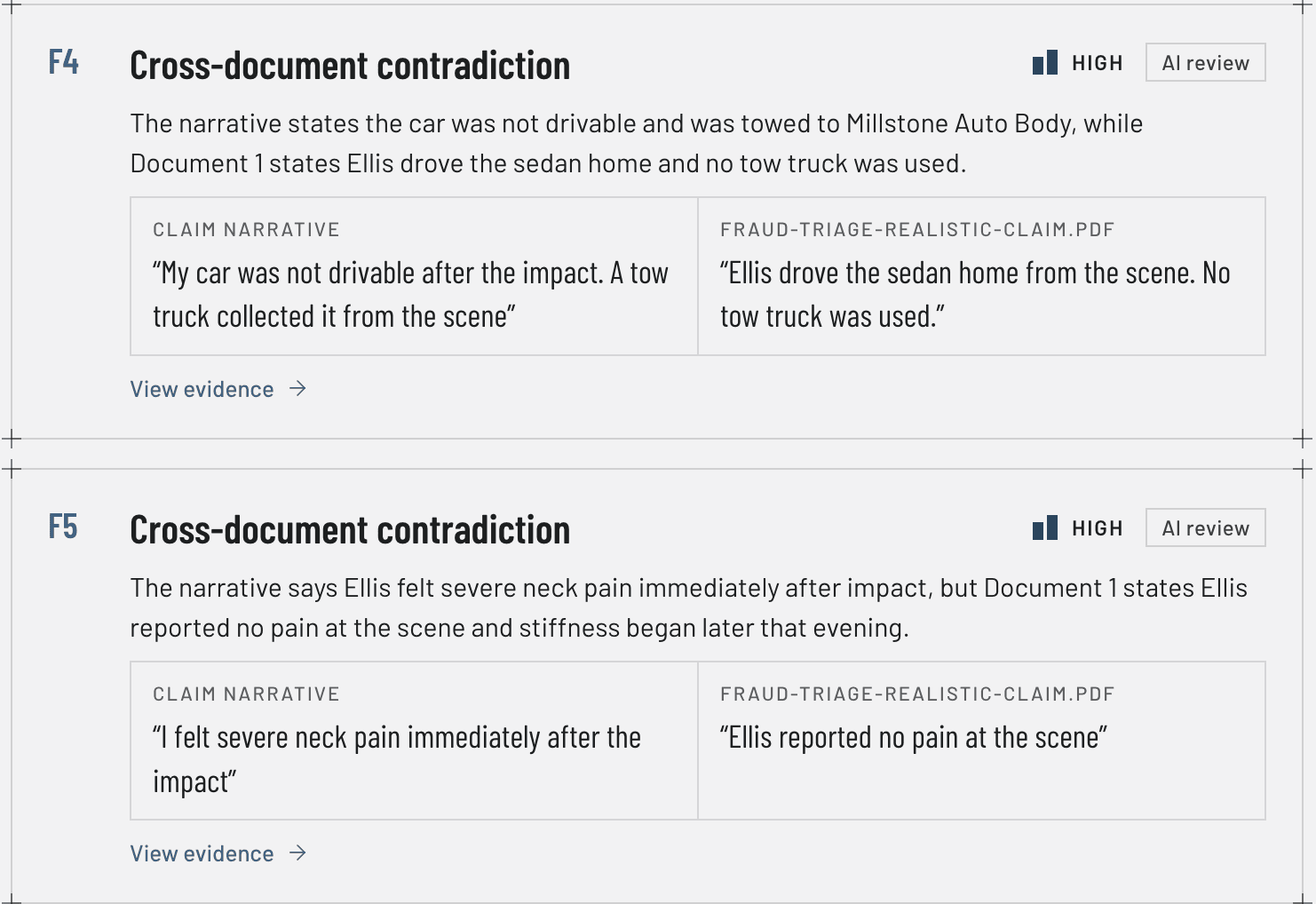
The flag, its reason, and the evidence behind it.
- 01
Both passages, side by side
The claim narrative and the document are quoted next to each other, with the document named, so a reviewer can check the contradiction without hunting through the file.
- 02
Labeled by source and severity
Each flag says whether the AI review or a rule check raised it, and how much it matters: Low, Medium or High.
- 03
A reason to look, not a conclusion
A contradiction can have an innocent explanation. The flag asks for a closer look; it doesn't decide anything.
- 04
Rule checks state their reason
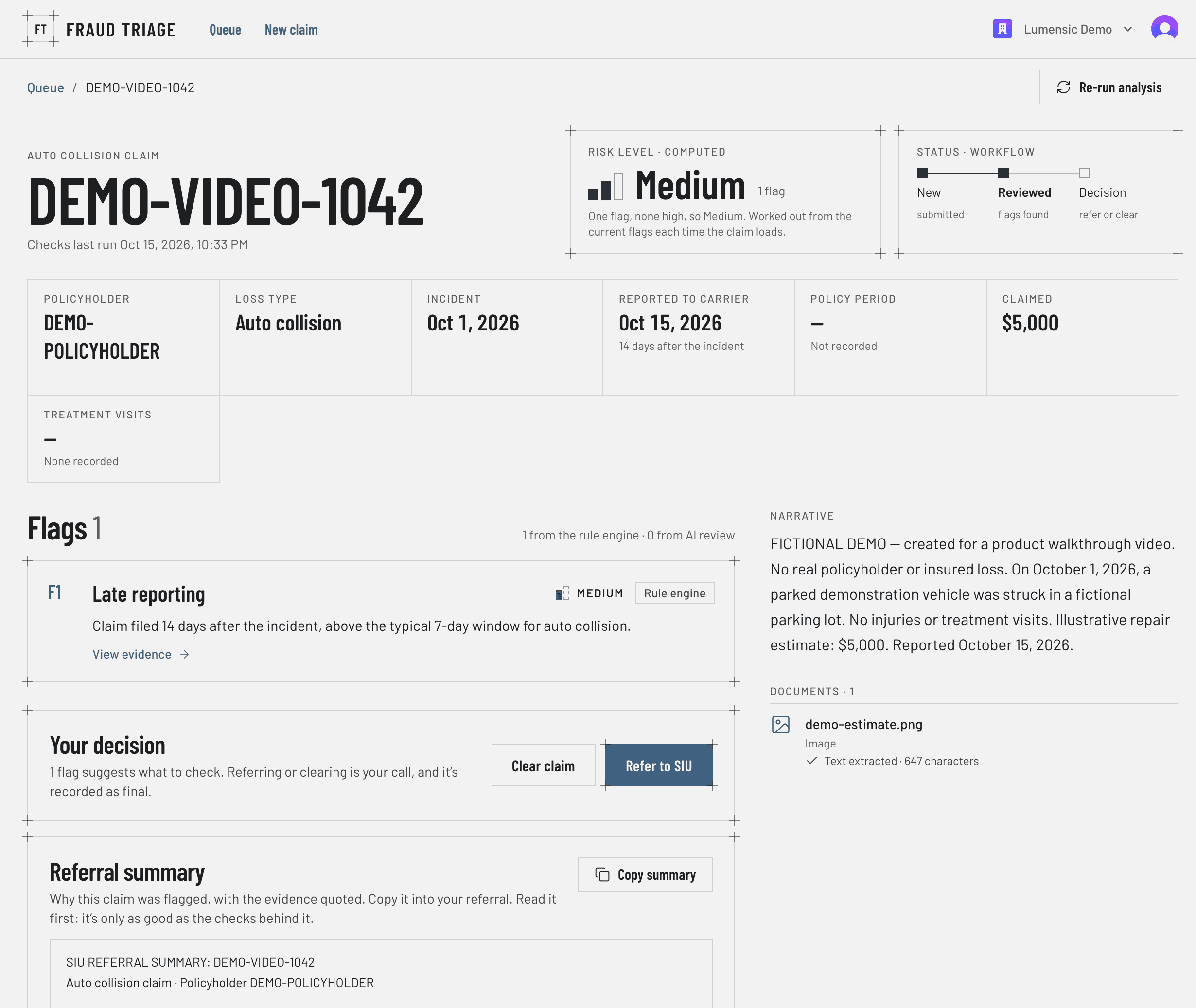
A rule flag names what was found and why it matters, such as a claim filed 14 days after the incident, and links to the evidence.
- 05
A risk level that explains itself
"One flag, none high, so Medium." The level is worked out from the current flags each time the claim loads.
- 06
A decision only a person makes
Clear the claim or refer it to SIU. The choice is recorded as your adjuster's, with a referral summary ready to copy.
Rule checks and an AI review, each with its reason.
Fraud Triage is built for claims teams deciding whether to refer a claim, and for the SIU teams who receive those referrals. Every result says where it came from.
- Late reporting: a loss reported later than the usual window for its type
- Policy timing: a loss soon after a policy began, or outside the policy period
- Repeat claims: several claims from the same policyholder in a short period
- Claimed amount: an amount above the ceiling for its loss type
- Treatment vs. damage: treatment out of proportion to the damage claimed
- Contradictions, quoted: where the documents and the claim narrative disagree, with the passages behind each finding
- Every quote checked: each quote is checked against its document before it's shown
- A Low, Medium or High risk level that states its reason
- A referral summary ready to paste into your claims system
- A recorded decision: refer to SIU or clear
Every flag shows its source.
- 01
Upload the claim
Add the claim's details and up to 10 documents, 20 MB each, as PDF, JPEG or PNG. Scans and photos are read too.
- 02
Review the evidence
Rule checks and an AI review of the documents each flag what they find and say why. Document findings quote the passage they rest on.
- 03
Your team decides
Refer to SIU or clear. Fraud Triage never refers, clears or denies a claim on its own. It records the decision your adjuster makes.
Every finding sourced. Every decision yours.
A flag means something deserves a closer look, not that a claim is fraudulent. Fraud Triage surfaces potential inconsistencies and the evidence behind them. Referring, clearing or denying a claim is always a person's decision.
Your files, kept like evidence.
Encrypted, with our own key
Uploaded documents and claim text are encrypted by Lumensic, on top of our providers' encryption.
Separated by organization
Every claim belongs to one organization, and the server checks it on every request.
Invitation only
No public sign-up. An administrator sets up each organization and invites its people.
Activity logged
Opening, analyzing and deciding a claim is recorded with the person and the time.
We don't have a SOC 2 report yet.
See exactly what we do today →A six-week pilot on claims you've already closed.
Every claim in the pilot has a known outcome, so your team can compare each flag with what actually happened.
Six weeks
One week of setup, four weeks of use, and one week to review the results with your team and decide.
Free
The pilot conditions and the post-pilot price are agreed in writing before we start.
Closed claims only
30 to 50 closed auto-collision claims with their documents. No open claims.
Up to five people
Named users from your organization, invited by your administrator.
Deleted afterward
All pilot data is deleted within 30 days of the end, and we confirm it in writing.
Insurance first. Not insurance only.
Lumensic builds evidence-first software for decisions that rest on documents. Our tools read the file, point to the passage that matters, and leave the decision to a person. Fraud Triage is our first product. We'll take on other document-heavy work one clearly defined problem at a time.
- FounderElijah Melis
- Based inHighland Park, Illinois
- CompanyLumensic LLC, an Illinois limited liability company
- Contacthello@lumensic.com
Evaluate it on representative claim files.
Start with 30 to 50 closed claims your organization approves, and we'll review the findings with your team. Real claim data is used only under agreed security and data-processing terms, and deleted within 30 days of the pilot's end.
or email hello@lumensic.com · call (312) 478-5969